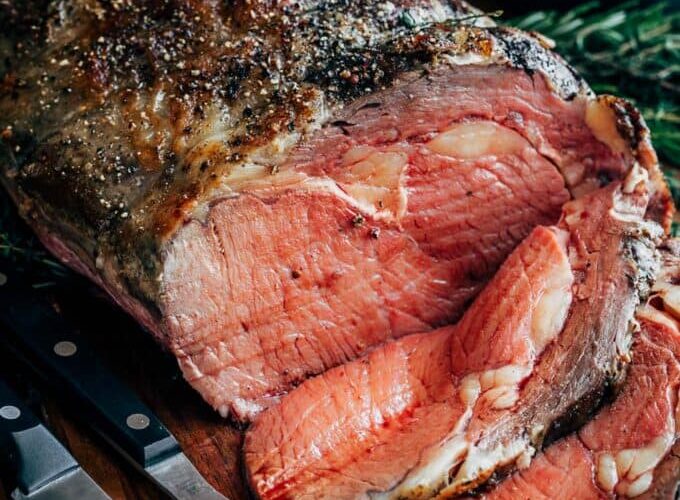
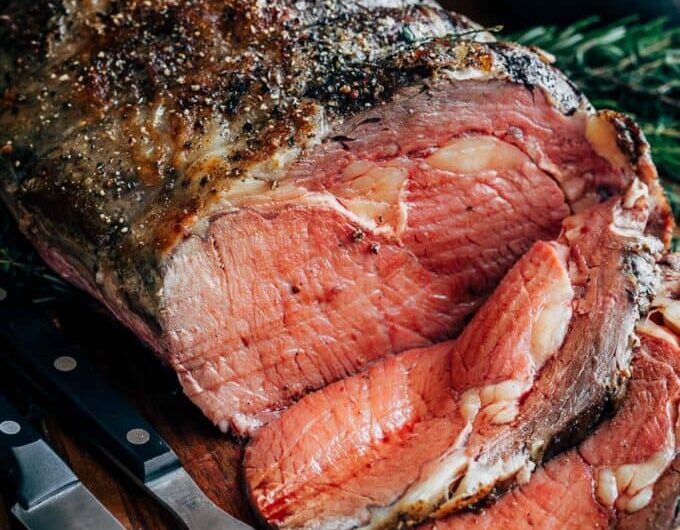
Slow roasted prime rib is a bone-in standing rib roast seasoned with salt and pepper the night before, slow roasted at 250F for 3 to 4 hours, rested for 30 minutes, then blasted at 500F for 5 to 10 minutes to build a crust. Serves 6 to 10.
Seasoning the roast the night before and leaving it uncovered in the fridge is the step that builds both flavour and crust. The salt draws moisture to the surface overnight, which dissolves the salt and pulls it back into the meat. The uncovered fridge time dries the exterior, which is what lets the 500F sear at the end form a proper crust instead of steaming.
The reverse sear method roasts low first and sears last, which is the opposite of most prime rib recipes. Slow roasting at 250F means the meat cooks evenly from edge to centre with almost no grey ring, and the juices stay inside the roast instead of pooling in the pan. There are fewer drippings for a gravy, but the meat is so juicy it does not need one.
Slow Roasted Prime Rib
Course: DinnerCuisine: AmericanDifficulty: Easy6
servings1
hour30
minutes3
hours35
minutes541
kcalA bone-in standing rib roast salted overnight, slow roasted at 250F until the centre hits your target temperature, rested under foil for 30 minutes, then seared at 500F for a crisp crust. Salt, pepper, and time. Nothing else needed.
Ingredients
6 to 12 pound standing rib roast, bone-in
Kosher or sea salt
Freshly cracked black pepper
Directions
- Season overnight:The day before roasting, season the prime rib liberally on all sides with salt and pepper. Place fat side up on a heavy baking sheet and refrigerate uncovered for up to 24 hours.
- Temper:Remove from the fridge and let stand at room temperature for 2 hours before roasting.
- Slow roast:Preheat oven to 250F with the rack in the lower third. Place the roast fat side up on a V-rack in a roasting pan. Roast for 3 to 4 hours until a thermometer reads 120 to 125F for rare, 128 to 130F for medium rare, or 132 to 135F for medium.
- Rest:Remove from the oven, tent loosely with foil, and rest for 30 minutes.
- Reverse sear:Increase oven to 500F. Uncover the roast and sear for 5 to 10 minutes until the exterior is brown and crisp.
- Carve and serve:Snip the twine, lift the meat from the bones, and slice. Serve with horseradish cream sauce on the side.
FAQs
How much prime rib should you buy per person?
One pound per person on the bone, which works out to roughly 2 adults per rib. A 4-rib roast feeds 8, a 3-rib feeds 6. Ask the butcher for the loin end (first cut), which is leaner and more tender than the chuck end (second cut).
What is the reverse sear and why does it work?
Standard prime rib sears first at high heat, then roasts low. The reverse sear does the opposite: roast low first, rest, then blast at 500F at the end. Slow roasting at 250F cooks the meat evenly from edge to centre with almost no overcooked grey ring, and the final sear builds the crust in minutes without overcooking the interior.
Why is there almost no pan dripping with this method?
Because the juices stay in the meat instead of rendering into the pan. That is the whole point of slow roasting at 250F. If you want a jus or gravy, use boxed beef broth as your base rather than counting on drippings. The trade-off is worth it for the juiciness of the slices.
How do you know when it is done?
An instant-read thermometer is the only reliable method. Pull at 120F for rare, 128F for medium rare, 132F for medium. The temperature will rise another 5 to 10 degrees during the 30-minute rest. The author’s 11-pound 4-rib roast hit 120F in about 3 hours and 20 minutes.
How do you store and reheat leftover prime rib?
Slice and refrigerate for up to 4 days. Warm gently in beef broth on the stove, or eat cold on sandwiches. The author suggests roast beef sandwiches, breakfast hash, or pho as leftover ideas. Freezes for up to 3 months tightly wrapped.