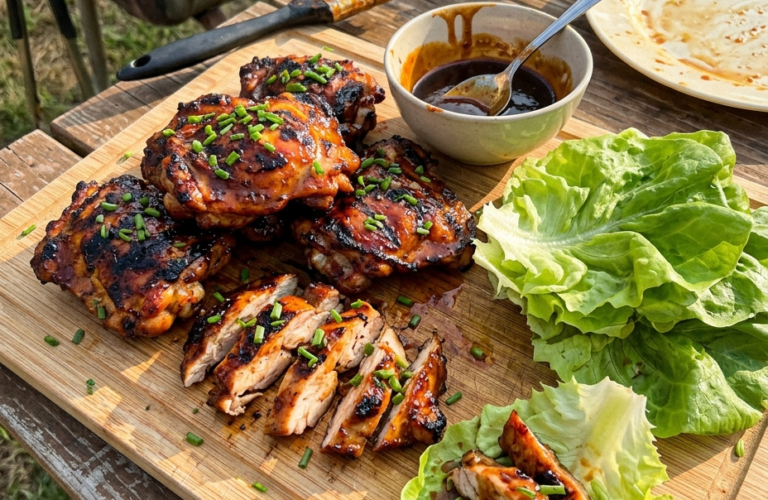
Sticky Glazed Chicken Thighs are an easy summer dinner made with boneless thighs grilled under an orange juice, ketchup and brown sugar glaze. Because the chicken grills in under ten minutes, this quick recipe suits weeknight dinners, cookouts, game day or a light family supper outside.
Simmer the glaze the full fifteen minutes, because thin glaze runs straight off the chicken and drips into the fire. It should coat the back of a spoon before it goes near the grill, so patience here decides everything.
This version builds the glaze on orange juice rather than a straight barbecue base, so the sweetness reads bright instead of heavy. Slicing the thighs into strips for butter lettuce wraps also turns a grilled main into something you eat with your hands.

Sticky Glazed Chicken Thighs
Course: DinnerCuisine: AmericanDifficulty: Easy4
servings10
minutes25
minutes445
kcalOrange juice, ketchup, brown sugar, vinegar and Worcestershire simmer down into a thick glaze split between brushing and serving. Oiled thighs grill hot on both sides, get sliced into strips and go into butter lettuce leaves.
Ingredients
1 cup orange juice
½ cup ketchup
¼ cup light brown sugar
2 tablespoons white wine vinegar
1 tablespoon Worcestershire sauce
Pinch red pepper flakes
8 boneless, skinless chicken thighs
Canola oil, for brushing
Salt and freshly ground black pepper
2 tablespoons chopped fresh chives (optional)
Butter lettuce leaves, for wrapping
Directions
- Make the glaze:Put the orange juice, ketchup, brown sugar, vinegar, Worcestershire sauce and red pepper flakes in a medium saucepan and bring to a boil over high heat. Reduce to low and simmer, stirring occasionally, until thick, about 15 minutes.
- Divide the glaze:Keep about ½ cup warm for serving and set the rest aside for glazing.
- Prep the chicken:Preheat the grill to high. Brush the thighs with oil on both sides and season with salt and pepper.
- Grill the first side:Grill smooth side down, covered, until lightly charred, 3 to 4 minutes.
- Flip and glaze:Flip and brush generously with the glaze. Cook covered until charred and just cooked through, another 3 to 4 minutes. Flip again, glaze once more and cook uncovered about 1 minute.
- Rest and serve: Move the chicken to a cutting board, sprinkle with chives if using and rest a few minutes. Slice into thin strips and serve with butter lettuce leaves and the reserved glaze on the side.
FAQs
Why set aside half a cup of glaze before brushing the chicken?
Once the brush touches raw chicken, the whole pot of glaze is contaminated and cannot safely go on the table. Pulling half a cup out first gives you a clean dipping sauce with no extra work at the very end. You could boil the used glaze for a full minute instead, though reserving some is faster and safer.
Why does the glaze only go on after the first flip?
A quarter cup of brown sugar plus ketchup burns fast, so early glazing chars the outside before the inside cooks. The first three or four minutes are for building grill marks on bare, oiled chicken instead of sauce. Each later coat gets less time on the heat, which is why the final glaze cooks only about a minute.
What internal temperature should the thighs reach?
Thighs are safe to eat at 165 degrees, though most cooks pull them closer to 175 because the texture improves. Unlike breast meat, thighs hold enough fat and collagen that the extra heat makes them silkier rather than dry. Check the thickest thigh with an instant-read thermometer, since boneless pieces vary a lot in size and thickness.
Can you make these without a grill?
A cast iron grill pan over medium high heat gives you the closest result, so work in two batches. The broiler works too, with the rack about six inches down and the same glazing pattern as the grill. Watch closely either way, because a sugary glaze under a broiler goes from caramel to black very quickly.
Why butter lettuce for the wraps?
Butter lettuce leaves are soft and naturally cup shaped, so they fold around hot chicken without cracking apart. Romaine and iceberg both split at the spine, which sends warm glaze running straight down your wrist instead. Separate the head gently under cold running water, since the outer leaves tear easily when you pull them dry.